
Utilising Electra 92 for SEM applications
Scanning electron microscopy (SEM) is a widely used method for the characterisation of micro- and nanostructures such as they are generally produced by lithographic methods. An electron beam is moved over the object to be imaged (scanned). The interactions of the emitted electrons with the substrate are used to generate an image of the object. Images/pictures of the object surfaces as typically produced with a scanning electron microscope have a high depth of field. In particularly in the case of insulating substrates however, a fast electrostatic charging of the surface occurs which deflects the incident electron beam and thus interferes severely with a precise imaging. In these cases, the quality of the image can be significantly improved by vapour deposition (sputtering) of precious metals such as gold or palladium, since the surplus electrons can then be discharged via the metal layer. The application of precious metals however also has its disadvantages; some structures change irreversibly due to the occurrence of thermal effects, and the use of precious metals is expensive. Recent investigations conducted by Mr Hentschel (4th Physics Institute and Research Center SCoPE, University of Stuttgart) demonstrated that the conductive coating Electra 92 can be used as an alternative. The coating on highly electrically insulating polymers or also on glass allowed a high-quality imaging of nanostructures in SEM:
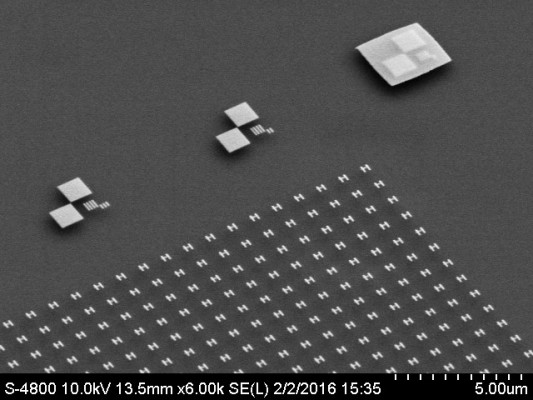
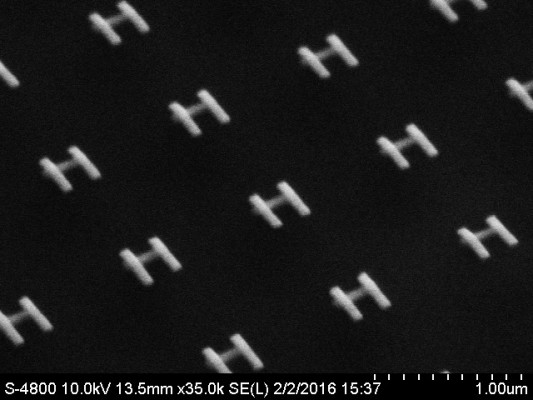
Images of highly insulating polymer structures
(coated with Electra 92, AR-PC 5090.02) in SEM
After SEM analysis, the conductive coating can completely be removed with water.
Overview of photoresist FAQs
AR-N 7700-4um thick-proximity effect
Chemically amplified, highly sensitive negative e-beam resist SX AR-N 7730/37
Diffractive optics with the “analogous“ e-beam resist
High-resolution negative e-beam resist
High-resolution negative e-beam resist AR-N 7520.17new for etching application
Medusa 82 for EUV applications
Medusa 82 with photoacid generator (PAG)
Medusa 82 – the alternative to HSQ-resists, storage stability
Medusa 82: Influence of post exposure bake (PEB)
Ratio resolution and dose, exemplarily shown for e-beam resist SX AR-N 7530/1)
Sensitive, etch-stable negative e-beam resist for processes without yellow light
Utilising Electra 92 for SEM applications
 Techpoint 久理企業