
Medusa 82 with photoacid generator (PAG)
One disadvantage of HSQ and Medusa 82 is the comparably low sensitivity, which can however be increased by an addition of photoacid generators.
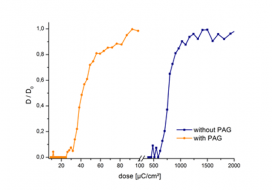
Sensitivity increase by a factor of 20 after addition of PAG (30 kV)
- Resist: SX AR-N 8200.06/1 – 100 nm
- Coating: 60 s 4000 rpm
- Soft-bake: 15 min @ 120°C
- Exposure: 30 kV
- Development: 90 s AR 300-44; 23 °C
- Stopping: 30 s DI-water
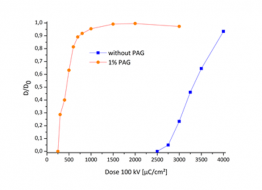
Sensitivity increase by a factor of 5 after addition of PAG (100 kV)
- Resist: SX AR-N 8200.06/1 – 100 nm
- Coating: 60 s 4000 rpm
- Soft-bake: 10 min @ 130 °C
- Exposure: 100 kV
- Development: 90 s AR 300-44; 23 °C
- Stopping: 30 s DI-water
In the case of e-beam exposure at 30 kV, the sensitivity could be increased by a factor of 20, and at 100 kV by about a factor of 5. The sensitivity can be adjusted by varying the PAG content in the resist.
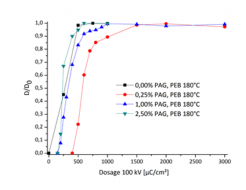
Sensitivity increase by a factor of 5 after addition of PAG (100 kV)
Interestingly, the sensitivity of the standard resist Medusa 82 (without PAG addition) can also be increased by a PEB (for example 5 min at 180 °C; see diagram, black line). The resist patterns obtained differ only slightly as compared to patterns with addition of PAGs (see Medusa: Influence of post exposure bake).
Overview of photoresist FAQs
AR-N 7700-4um thick-proximity effect
Chemically amplified, highly sensitive negative e-beam resist SX AR-N 7730/37
Diffractive optics with the “analogous“ e-beam resist
High-resolution negative e-beam resist
High-resolution negative e-beam resist AR-N 7520.17new for etching application
Medusa 82 for EUV applications
Medusa 82 with photoacid generator (PAG)
Medusa 82 – the alternative to HSQ-resists, storage stability
Medusa 82: Influence of post exposure bake (PEB)
Ratio resolution and dose, exemplarily shown for e-beam resist SX AR-N 7530/1)
Sensitive, etch-stable negative e-beam resist for processes without yellow light

