
UV-structuring of PMMA resists
PMMA resists can also be patterned using UV-lithography, but only at exposure wavelengths of 200 – 270 nm (deep UV light). Typically used is the wavelength-range of the lowest line of high-pressure mercury lamps at 254 nm. The image shows the UV absorption spectrum of a PMMA resist. Above a wavelength of 280 nm, the polymer shows no absorption and can thus not be exposed in this wavelength range.
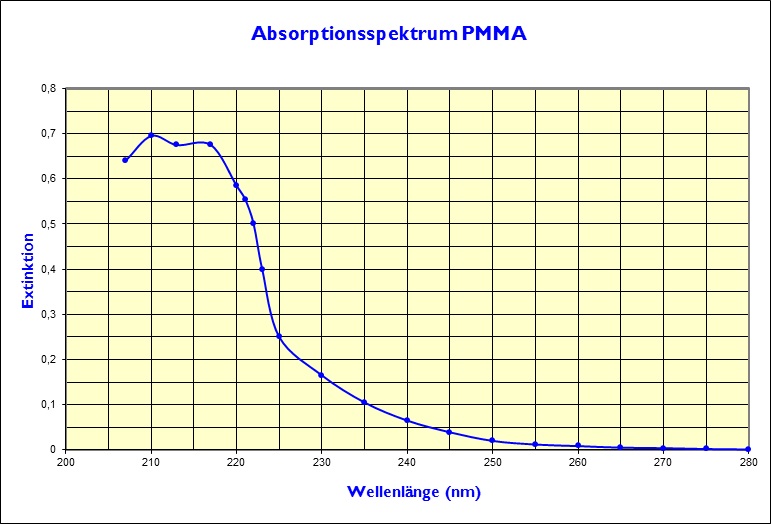
Absorption spectrum of a PMMA.
The sensitivity of PMMA at this wavelength is however low, in particular if high-pressure mercury lamps are used since only a small portion of the radiation is emitted at 254 nm. In addition it has to be ensured that no glass (lenses, filters) are present in the beam paths, since glass is impermeable for light less than 300 nm. Only quartz glass is suitable for 254-nm lithography. If laser light is used as source for the deep UV-lithography, more energy is available for exposure and PMMA resists can consequently be exposed with acceptable exposure times. After exposure, PMMA films are developed according to the procedure used in e-beam lithography (see Development PMMA films).
Overview of photoresist-others
Alkali-stable positive resist obtained after treatment with HMDS
Aqueous negative resist based on gelatine
Atlas 46 for nanoimprint lithography
Ethanol and toluene-resistant photoresist AR-U 4060
Fluorescent resist structures with photoresists
Laser ablation of PPA (Phoenix 81)
Negative CAR PMMA resist SX AR-N 4810/1
Positive polyimide one-layer resist
Resist for near infrared (NIR)
Structuring by ablation of the resist materials
Structuring of polyphthalaldehydes with photolithography
Surface imaging resist system SX AR-N 7100 – silylable photoresist
Top surface imaging (TSI) photoresist – principles
Two-layer photoresist system for water-sensitive substrates
Two-layer resist system for hydrofluoric acid etching
UV-structuring of PMMA resists
 Techpoint 久理企業