
Structuring by ablation of the resist materials
The basic principle of laser ablation is that laser irradiation of a certain wavelength introduces so much energy into the resist material which is modified for ablation that the resist polymer is destroyed and then vaporizes as low molecular weight fragments. This process can be promoted by introducing suitable dye additives. The result is transparent structures (ablated surfaces) in the otherwise opaque surface.
Within the scope of the Photoenco project (June 2016 – May 2019), protective resist samples with dyes were created. Layers of these samples were irradiated with a 532 nm laser of different intensity. The figure demonstrates that with increasing laser power, the layer is completely ablated.
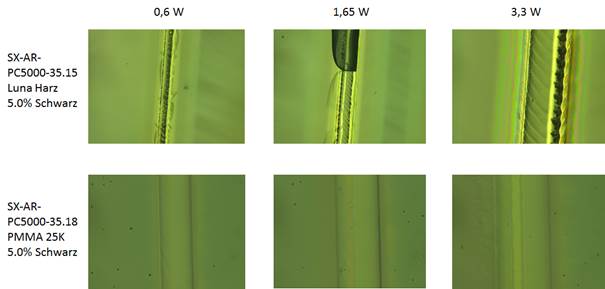
Figure: Lines written with 532-nm laser into PMMA and novolac layers
Resist samples for different laser wavelengths can be manufactured with appropriate dyes.
Overview of photoresist-others
Alkali-stable positive resist obtained after treatment with HMDS
Aqueous negative resist based on gelatine
Atlas 46 for nanoimprint lithography
Ethanol and toluene-resistant photoresist AR-U 4060
Fluorescent resist structures with photoresists
Laser ablation of PPA (Phoenix 81)
Negative CAR PMMA resist SX AR-N 4810/1
Positive polyimide one-layer resist
Resist for near infrared (NIR)
Structuring by ablation of the resist materials
Structuring of polyphthalaldehydes with photolithography
Surface imaging resist system SX AR-N 7100 – silylable photoresist
Top surface imaging (TSI) photoresist – principles
Two-layer photoresist system for water-sensitive substrates
Two-layer resist system for hydrofluoric acid etching

