
Bleachable resists
The basic idea behind dyed resists developed within the scope of the Photoenco project (June 2016 – May 2019) was that dyes are mixed into the polymer matrix of the resist which then either change their colour or become colourless upon irradiation.
During the fabrication of the first samples it however soon became apparent that the version of dyes changing their colour upon irradiation would not be favoured. Most dyes which were merely intended to change their colour turned out to be not stable enough for the required process conditions and temperatures. It was thus searched for dyes that are decomposed by energy input upon laser irradiation – the resist consequently bleaches in these areas.
Since a 532 nm laser should be used for the later process and since also the ablation experiments were carried out at this wavelength, we focused our attention on dyes with high absorption at this wavelength. In addition to red and violet dyes, classically also black dyes come into question. After first internal tests with a suitable dye, one sample (SX AR-N 4340/13.1) was submitted to the Institute of Technical Optics of the University of Stuttgart (ITO) for further investigation. The advantage of this resist system was the optical density of the resist. The ITO was able to successfully write lines into the resist without ablating it (Figure 1). Figure 2 and 3 show that unwanted ablation results if the intensity of the laser beam is too high.

Fig 1: Lines written at the ITO Stuttgart by bleaching the dye with laser irradiation.
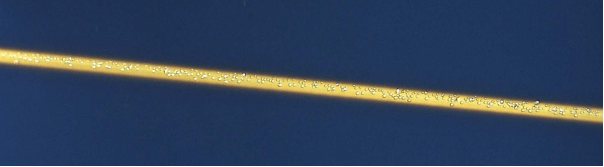
Fig 2: Lines written at the ITO Stuttgart by bleaching the dye with laser irradiation of too high intensity – incipient ablation.
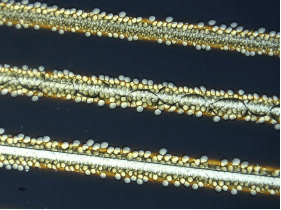
Fig. 3: Lines written at the ITO Stuttgart by bleaching the dye with laser irradiation of far too high intensity – significant ablation.
Overview of photoresist-others
Alkali-stable positive resist obtained after treatment with HMDS
Aqueous negative resist based on gelatine
Atlas 46 for nanoimprint lithography
Bleachable resists
Ethanol and toluene-resistant photoresist AR-U 4060
Fluorescent resist structures with photoresists
Laser ablation of PPA (Phoenix 81)
Negative CAR PMMA resist SX AR-N 4810/1
Positive polyimide one-layer resist
Resist for near infrared (NIR)
Structuring by ablation of the resist materials
Structuring of polyphthalaldehydes with photolithography
Surface imaging resist system SX AR-N 7100 – silylable photoresist
Top surface imaging (TSI) photoresist – principles
Two-layer photoresist system for water-sensitive substrates
Two-layer resist system for hydrofluoric acid etching

