
Atlas 46 for nanoimprint lithography
The new development Atlas 46 could also be successfully used for nanoimprinting (University of Wuppertal, working group of Prof. Scheer). In a first step, nanostructures were produced with the negative-working resist Atlas 46S and cured with UV light at a wavelength of 172 nm. The subsequent imprint step then yielded the desired hierarchical architecture.

a) Realization of defined nanostructures by thermal imprinting
b) Stabilization of the pre-structured surface by deep UV exposure
c) Second imprint step to generate the hierarchical architecture
For this special application, different resists were evaluated:
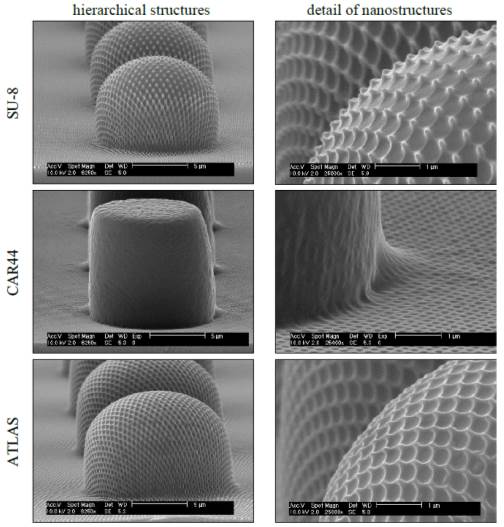
SU 8 and Atlas-resists show similarly good results since defined and very uniform structures could be generated, while CAR44 does not have the thermal stability required for this process. The big advantage of Atlas-resists however is the easy removability of the R-variant.
Overview of photoresist-others
Alkali-stable positive resist obtained after treatment with HMDS
Aqueous negative resist based on gelatine
Atlas 46 for nanoimprint lithography
Ethanol and toluene-resistant photoresist AR-U 4060
Fluorescent resist structures with photoresists
Laser ablation of PPA (Phoenix 81)
Negative CAR PMMA resist SX AR-N 4810/1
Positive polyimide one-layer resist
Resist for near infrared (NIR)
Structuring by ablation of the resist materials
Structuring of polyphthalaldehydes with photolithography
Surface imaging resist system SX AR-N 7100 – silylable photoresist
Top surface imaging (TSI) photoresist – principles
Two-layer photoresist system for water-sensitive substrates
Two-layer resist system for hydrofluoric acid etching
 Techpoint 久理企業