
Highly sensitive e-beam resist AR-P 617 (PMMA-copolymer)
The copolymer composed of methyl methacrylate and methacrylic acid is, in contrast to the pure PMMAs, able to form a 6-membered ring during thermal loading. In this case, two methacrylic acid groups must be located adjacent to each other in the polymer chain (see structural formula), which statistically occurs with sufficiently high frequency at a mixing ratio of 2: 1 (PMMA: methacrylic acid). The reaction is possible at a temperature of 190-210 ° since the produced water is a very good leaving group. During irradiation with electrons, the formed 6-membered ring is easier to break apart than the aliphatic radical chain. This results in a higher sensitivity of the copolymer. The adjusted sensitivity then remains unchanged, a reverse reaction with ring opening is impossible.
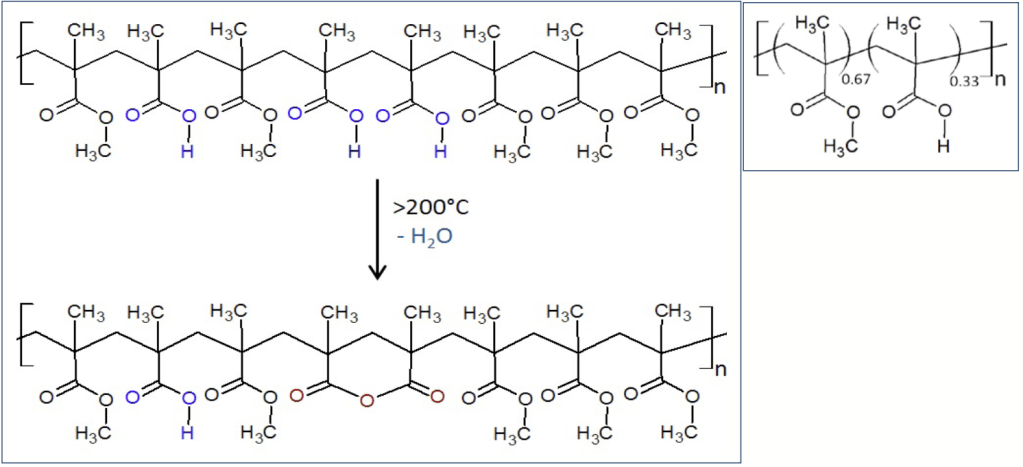
Fig.: Dehydration of the PMMA copolymer
See New developer for AR-P 617
Related articles EBL positive
CSAR 62 related
3-layer system CSAR/PMMAcoMA/PMMA
3-layer system for T-gate CSAR/PMMAcoMA/PMMA
BOE etching of SiO2 with CSAR 62 mask
Collapse of extreme high-resolution e-beam resist structures
CSAR 62 Avoidance of particles during large-area exposures
CSAR 62 – Development at low temperatures
CSAR 62 – Experimental studies on new, sensitive developers
CSAR 62 lift-off for thick layers
CSAR 62 nanostructures written at 100 kV
CSAR 62 single layer lift-off system
Evaluation of various developers for e-beam exposed CSAR 62 layers (100 kV)
HF etching of GaAs with CSAR 62 masks
Manufacture of plasmonic nanostructures with CSAR 62
Use of CSAR 62 for the manufacture of nanostructures on GaAs substrates

