
Collapse of extreme high-resolution e-beam resist structures
A typical problem arising from an extreme resolution at an aspect ratio of > 10 is the collapse of bar structures. In Fig. 1, 10-nm bars with a pitch of 50 nm are displayed. These structures were realised with CSAR 62 (SX AR-P 6200/2) at an acceleration voltage of 30 kV and a dose of 230 pC/cm. The CSAR 62 is a further development of the ZEP resist. During the development process, the surface tension of the solvents leads to an undesired “sticking together” of single bars. Currently experiments are carried out to minimize this effect with optimised developers and the use of surface tension-altering substances.
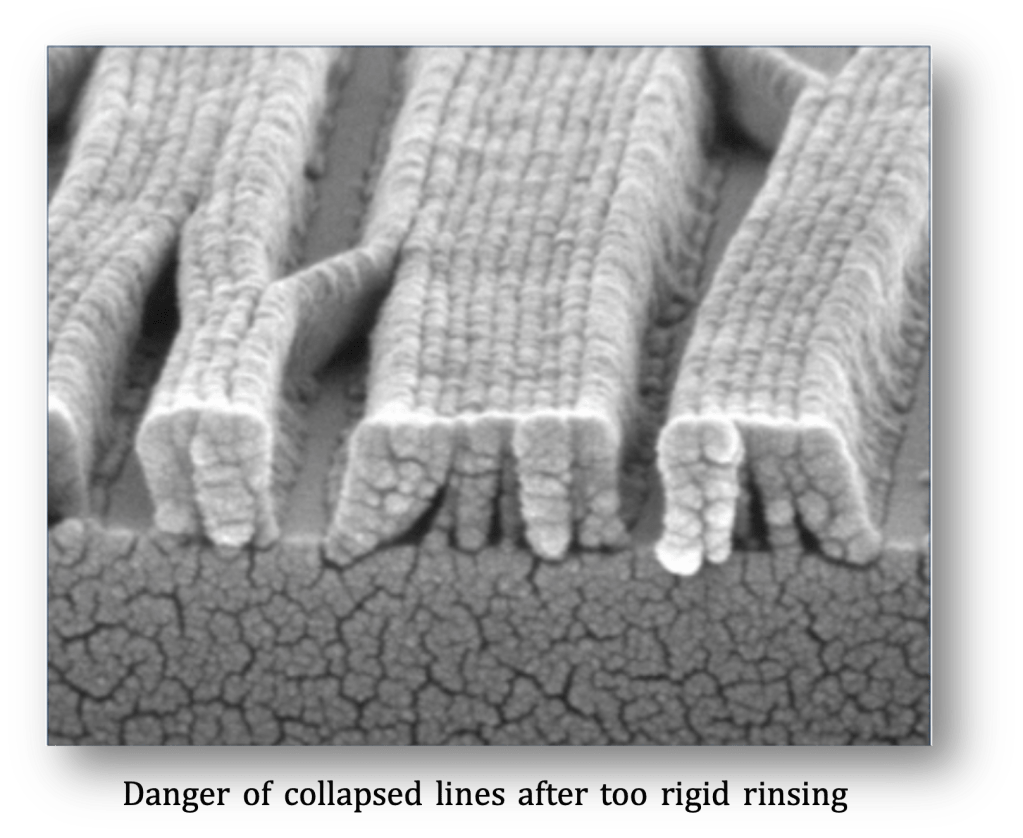
Fig. 1: 10-nm bars still partly stick together (pitch 50 nm)
Related articles EBL positive
CSAR 62 related
3-layer system CSAR/PMMAcoMA/PMMA
3-layer system for T-gate CSAR/PMMAcoMA/PMMA
BOE etching of SiO2 with CSAR 62 mask
Collapse of extreme high-resolution e-beam resist structures
CSAR 62 Avoidance of particles during large-area exposures
CSAR 62 – Development at low temperatures
CSAR 62 – Experimental studies on new, sensitive developers
CSAR 62 lift-off for thick layers
CSAR 62 nanostructures written at 100 kV
CSAR 62 single layer lift-off system
Evaluation of various developers for e-beam exposed CSAR 62 layers (100 kV)
HF etching of GaAs with CSAR 62 masks
Manufacture of plasmonic nanostructures with CSAR 62
Use of CSAR 62 for the manufacture of nanostructures on GaAs substrates
 Techpoint 久理企業